Why I selected this piece
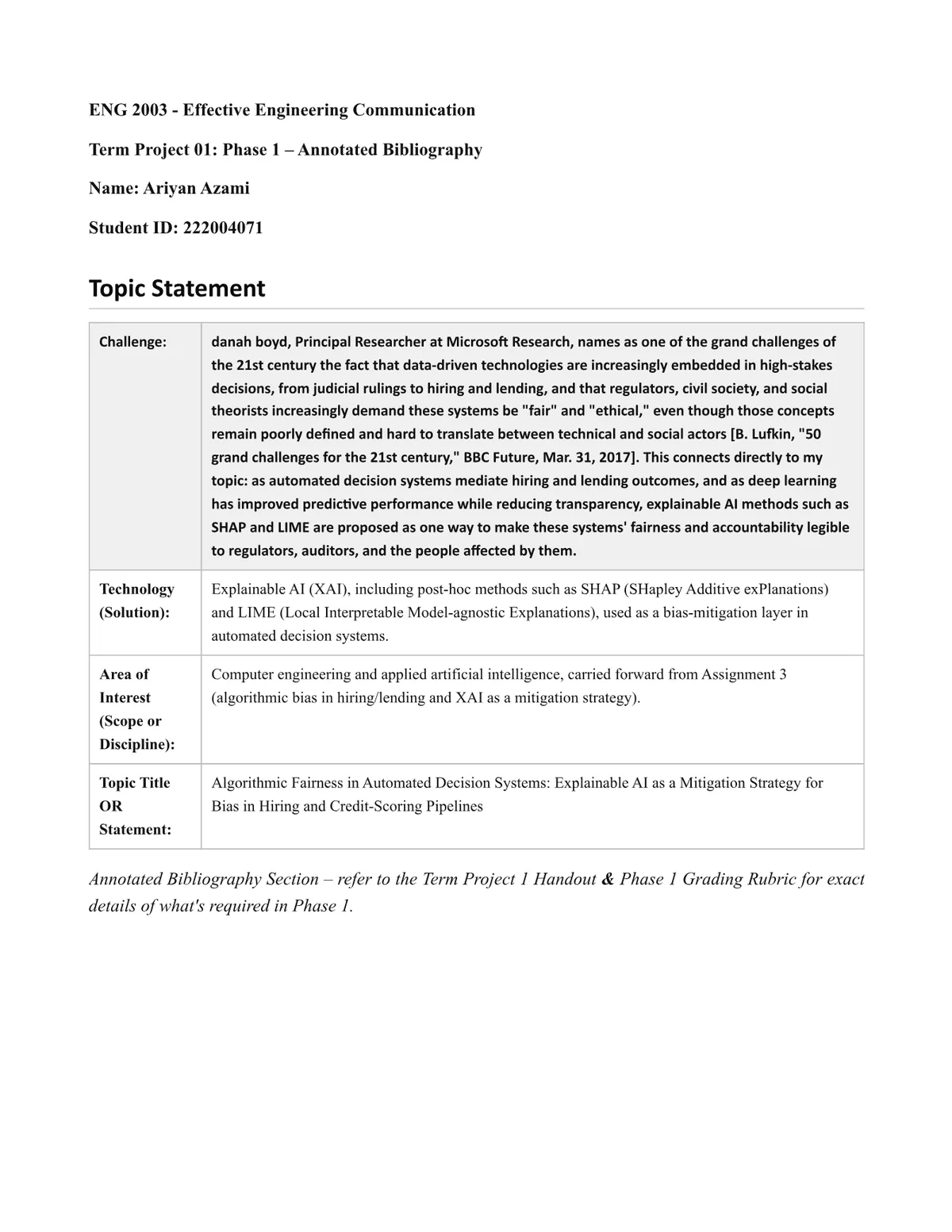
This is the most demanding document I have written. It argues that explainable AI methods, specifically SHAP and LIME, should be deployed as a mandatory audit layer in automated hiring and credit-scoring systems, and it has to hold that argument together across a letter of transmittal, an executive summary, two original figures, two tables, and eleven references in IEEE format. I selected it because it is the one piece where every part of the course had to work at once: research, structure, visual design, citation, and tone.
What this piece says about my development as a communicator
The draft and the final report make the same argument, but only the final one manages the reader. Early on I wrote as though a correct sentence was a clear sentence. By Phase 4 I was building a path: the executive summary states the conclusion before the evidence, each figure is introduced and then interpreted rather than left to speak for itself, and the Shapley-value foundation of SHAP is explained in plain language before the formal properties appear. That shift, from presenting information to sequencing it, is the clearest change in how I write.
Did this piece push me out of my comfort zone?
Yes, in a way I did not expect. The technical content was familiar territory. What was uncomfortable was Appendix A, where I had to document the peer feedback I received and account for what I did and did not change. I declined one reviewer's suggestion to add a dollar cost estimate, on the grounds that SHAP and LIME are open-source libraries rather than capital equipment and a figure would have been speculative. Writing down a disagreement with a reviewer, and having to justify it in the document itself, was harder than writing the technical sections.
Is this my best work?
Yes. This is my best work in the course, and it is best because of how it is built rather than what it covers. The argument is fully evidenced, the document is complete and correctly formatted to IEEE, and the structure does the job I designed it to do: a reader can take the conclusion from the executive summary, test it against the two figures, and find the citation behind any claim without reading the report linearly. The reviewer who flagged an inconsistent register in my draft would not flag the final version, because the fix was structural rather than cosmetic. Its remaining weakness is length discipline. Some paragraphs in the Discussion carry more qualification than a reader needs, and conciseness is the C I am still worst at. That is now a problem I can name and locate in my own draft, which is the part that transfers: if I revised it again I would cut rather than add, the opposite of the instinct I started the term with.